


Large-scale garden transformations raise a familiar set of strategic questions. How long will the build take? How much disruption will it cause? Where can costs be managed intelligently? And how do you deal with a site that presents genuine technical challenges?
Our 2005 Guildford garden project addresses many of these considerations. Having worked with the client on a previous property, we were already familiar with their expectations. This time, the brief was to create something exceptional on a particularly challenging sloping site. The result was an award-winning garden that balanced high-end design with practical, cost-conscious construction.
This project offers several useful insights for anyone planning a complex landscaping build.
How do you plan a large garden project properly?
On complex sites, success is determined long before construction begins. For this project, we carried out a full site survey and held detailed design discussions to understand ground levels, drainage requirements and how the client intended to use the space.

The scale of excavation, which involved around 500 tonnes of material, meant that planning permission formed a key part of the early programme. Local residents were consulted at an early stage, helping to avoid delays later when access restrictions became necessary.
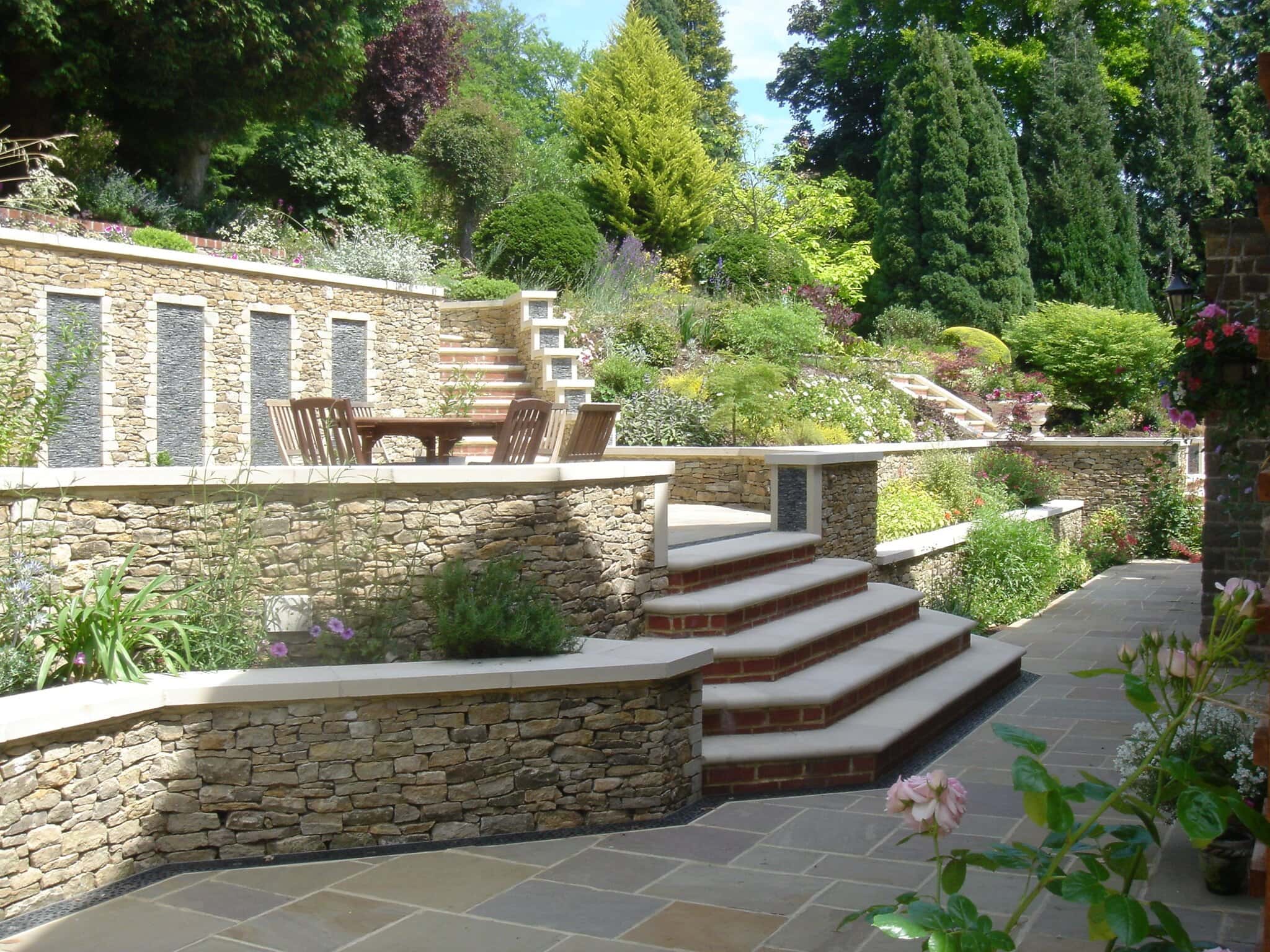
During the design phase, the layout was refined to reduce excavation depth and introduce a mid-level terrace. This improved natural light, created more usable outdoor space and reduced unnecessary disruption to the site, all of which aligned closely with the client’s priorities.
Can you reuse materials in landscaping to save money?
Material reuse is often a strategic decision on large-scale garden projects, delivering cost efficiencies without compromising design integrity. It also supports a more sustainable approach to construction.
On this project, approximately 250 tonnes of chalk excavated on site were reused to form new terraces and improve gradients across the garden.

All original walling stone was also salvaged and reused, with smaller offcuts incorporated into pathway and step detailing. This approach saved the client around £10,000 in new material costs and helped ensure the finished garden felt grounded in its original setting rather than imposed upon it.
What happens if structural issues are found during landscaping?
On projects of this scale and age, hidden structural conditions are not uncommon. During excavation, three underground voids were discovered. Two were assessed by engineers and safely filled with reinforced concrete.

The third void was repurposed into a rainwater harvesting tank, feeding roof drainage into a soakaway system. Combined with a wider drainage strategy across the terraces, this helped manage surface water effectively and protect the property over the long term.
Each issue was addressed methodically, with appropriate technical input and regulatory oversight. This measured approach ensures projects remain safe, compliant and built to last.
How important is drainage in garden design?
On sloping and multi-level sites, drainage strategy is fundamental to long-term performance. Poorly planned systems can lead to standing water, compromised planting and, in some cases, damage to nearby structures.
For this project, integrated drainage channels, soakaways and water harvesting systems were designed alongside the layout from the outset.
This ensured water was directed safely away from key areas, allowing the garden to perform reliably in all weather conditions while reducing future maintenance requirements.
How do you make a garden feel connected to the house?
Good landscaping should feel like a natural extension of the architecture. Here, terrace lines and wall angles were designed to echo the geometry of the property’s bay windows.
Attention to detail was critical in ensuring cohesion between house and landscape. Drainage grilles were matched to original air brick patterns, while blue slate found on site was reused within the main retaining wall and enhanced with integrated lighting to extend the usability of the space into the evening.

These details help the garden feel deliberate, balanced and visually connected to the home.
Why does delivering a garden on a fixed deadline matter?
Programme control is as critical as design on large-scale residential projects. Clients often plan around family events, seasonal use or wider building schedules that cannot easily be moved.
This project carried a fixed twelve-week deadline due to a family celebration at the property. To meet it, the build was carefully phased, and priority areas were completed early.
Final paving works were finished the evening before the event. For the client, this provided confidence that the garden would be ready on time without any compromise in quality.
What does the homeowner gain from a complex landscaping project?
Beyond awards, the real value lies in how the space performs over time. This project delivered:
- More usable outdoor levels
- Improved garden lighting across the terraces
- Reduced material costs through intelligent reuse
- Robust drainage and water management
- A garden designed around genuine lifestyle needs
It also reinforced a long-standing client relationship. Long-term collaborations allow projects to be more ambitious, more considered and ultimately more successful for everyone involved.
Thinking about transforming your garden?
If you are planning a complex garden project and want a team experienced in challenging sites, tight programmes and long-term value, we would be pleased to help.
Contact Paul and the PC Landscapes team to begin planning a garden that works for your home, your lifestyle and your future.